
 Posted by
 The thyroid gland is very important. And if it’s not working properly, you FEEL it.
It’s located in the front of the neck. It sits over your windpipe (called the trachea), under your voice box (called the larynx) between and just above the collarbones (photo below). It looks like a butterfly because it has right and left lobes. Thyroid hormone (TH) is created here and released into the blood stream. Iodine is important to make thyroid hormone. This little factoid will be important later in this post. The thyroid hormone releases into the bloodstream when it’s told to. The brain’s pituitary gland secretes thyroid stimulating hormone (TSH) into the bloodstream, then tells the thyroid to release TH. When TH gets released, your metabolism wakes up, and your body temperature increases, also. That’s why when people have an overactive thyroid (HYPERthyroidism), they feel hot all the time. Once the thyroid responds to the brain’s orders, the brain stops releasing TSH and all is calm. Now, lots of complications can arise from this teamwork. Let’s expand on this.
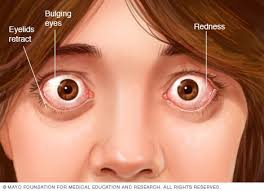
More on hyperthyroidism, or overactive thyroid. The thyroid will start producing and releasing excessive TH into the blood stream. People victim of this have high metabolisms thus lose weight without trying, feel hot all the time, and have lots of energy. Their heart rate can even be elevated and they may notice more bowel movements or even diarrhea. Irritability, fatigue (from all the stimulation), and mood swings are also noted. Hyperthyroidism happens for a couple of reasons, but the more common ones are that the brain’s stimulation of the thyroid has gone haywire or that the person has Grave’s disease. Grave’s disease is an autoimmune disease, and is noticeable immediately upon looking at a person due to their eyes protruding/bulging from their head (photo below). This physical characteristic is called exophthalmos. FUN FACT to tell your friends: Hip-Hop artist Missy Elliot and talk show host Wendy Williams have this condition. Your blood work will show a low TSH level because the thyroid hormone, which is in excess in the body, tells the brain to stop releasing the TSH. The treatment for overactive thyroid is taking oral medication, injecting the thyroid with radioactive iodine, or just removing the gland all together. If you have a thyroidectomy (removal of the thyroid), you must take thyroid hormone by mouth the rest of your life.
On the flip side, if the thyroid doesn’t respond to the brain’s orders, the brain will amp up its secretion of TSH. It’s trying to wake up a sleeping thyroid. It’s like your alarm clock getting louder and louder the longer you don’t hit snooze. So, that would mean the thyroid is HYPOactive, and the TSH in your blood work would be high. A high TSH level = lazy thyroid. People with this condition are tired, cold all the time, gain weight without trying and/or can’t seem to lose weight, have dry skin, brittle nails and hair, and even complain of light sensitivity in the eyes (called photophobia). They also may have constipation. Americans usually have an under-active thyroid because their immune system is attacking the gland, called Hashimoto’s Disease. Worldwide, particularly in third-world countries, a lack of iodine in the diet is the cause of inadequate thyroid hormone being produced. This is why salt is iodized and sold in our stores that way. Have you seen someone with a goiter? It’s a large mass that arises from the thyroid due to poor intake of iodine. See? There’s at least one good thing about salt!
Another cool function of the thyroid is the production of calcitonin. Calcitonin takes calcium that’s floating in the blood stream and puts it into the bone. It literally helps to build new bone. Important stuff!
Moreover, if you feel you may have a thyroid issue, ask your primary care provider to run some tests. If you feel your gland is enlarged and looks like a mass on the front of your neck, ask for an ultrasound. (More celebrity trivia: Tarek El Moussa from HGTV’s Flip or Flop had a noticeable thyroid mass that caught a viewer’s eye…turns out he had stage 2 thyroid cancer! Best fan ever award?) If you feel like you’re having more of the metabolic symptoms I discussed, blood work can be ordered. The blood work does not require you to fast or abstain from eating. They’ll likely order T3, T4, and TSH. T3 and T4 are your 2 thyroid hormones. Mostly, though, the TSH is important. If TSH is lower than normal, it’s likely that you have hyperthyroidism. If TSH is elevated, you have hypothyroidism and need to take daily thyroid hormone. The form I prescribe is levothyroxine. It has to be taken in the morning on an empty stomach, at least 30 minutes prior to eating or drinking anything else. It’s dosed in micrograms (1/1000 of a milligram) and it’s super sensitive. When adjusting this medication for people, a mere 12 microgram swing can mean a huge difference in the balancing act we try to achieve. Your primary care provider may send you to an endocrinologist if your thyroid requires complex management or an Ear, Nose, Throat specialist if your gland requires a biopsy.
You may have heard of people having thyroid nodules. Maybe you have one, yourself. If you’re 65+ years old, you have a 50% chance of having one. A nodule is a small lump or mass on the gland itself and is usually noncancerous (90% of them! Phew!). Sometimes, depending on where the nodule is located, it can press on your voice box, or can feel like something is preventing you from swallow properly. Sometimes you have no idea it’s there, and that’s okay. When nodules are found on an ultrasound or a CT scan, the larger or weird-looking ones get biopsied to make sure they’re benign.
Is thyroid disease hereditary? It can be. One study of 264 patients with Hashimoto’s disease (remember: under-active thyroid) showed that their first degree relatives (mother/father/sibling) had a 9x higher risk to develop the same. 46% of the 264 patients (121 of them) had at least one relative who was affected (Bothra et al, 2017). Grave’s Disease prevalence in families is seen if there are other autoimmune disorders amongst relatives. Heredity risk, however, is unclear based on current research. Thyroid nodules themselves are also seen in families, but being that they’re so common among the general population, a genetic link is up in the air.
I hope you understand your thyroid gland a little more than before! Take a look at some photos below if you’re a visual learner.


References:
Bothra N et al Hashimoto’s thyroiditis: relative recurrence risk ratio and implications for screening of first degree relatives. Clin Endocrinol (Oxf ). 2017 Aug;87(2):201-206.
InformedHealth.org. Cologne, Germany: Institute for Quality and Efficiency in Health Care (IQWiG); 2006-. How does the thyroid gland work? 2010 Nov 17 [Updated 2018 Apr 19]. Available from: https://www.ncbi.nlm.nih.gov/books/NBK279388/
Massachusetts General Hospital. FAQs about thyroid nodules. 2019. Retrieved October 28, 2910 from https://www.massgeneral.org/surgery/general-surgery/patient-resources/faqs-thyroid-nodules.
McKinley M and O’Loughlin VD. Human Anatomy. 2nd Edition. New York, NY. McGraw-Hill. 2008.
More on Tarek El Moussa’s thyroid cancer: https://www.today.com/news/how-hgtv-star-tarek-el-moussas-cancer-spotted-fan-changed-t58226
Figure 1: https://www.btf-thyroid.org/what-is-thyroid-disorder
Figure 3: https://www.mayoclinic.org/diseases-conditions/graves-disease/multimedia/exophthalmos/img-20007978
Featured image: https://www.medicalnewstoday.com/articles/322518.php
 Piece of Mind